Back to articles

Venice or the rediscovered real

October 2010CYBText
Venice or the rediscovered real

How to explain that this city, this Idea of beauty, can be missed to the point of extracting a painter from his abstract approach?

To be summoned to reality by such a marvel, by this city dreamed of by a thousand and one artists, by this proud and fragile attempt of men to reach the sky, is the experience of a rapture and a delight, of a boundary crossed that opens an unknown trembling with hope.

Here then is Venice, eternal homeland of youth and of the future. Time dilates there, the rhythm of the tide comes to break the ordinary structure, the disequilibrium of the elements gives rise to a baroque relationship with temporality.

Here then is Venice, as oriental as it is tropical, as archaic and animalistic as it is erudite and refined.

If the essence of painting is abstraction in the sense of style, of the singular arrangement of its own means — color, figure, matter — the vocation of painting is to express. Then the love and the longing for a place, a city, a being, the very longing for reality itself can be discovered at the heart of the pictorial gesture.

But is reality not essentially lacking, insofar as it is this singular experience of a perception mingled with memory? To make this reality visible, a work is needed — that of the writer, or of the painter.

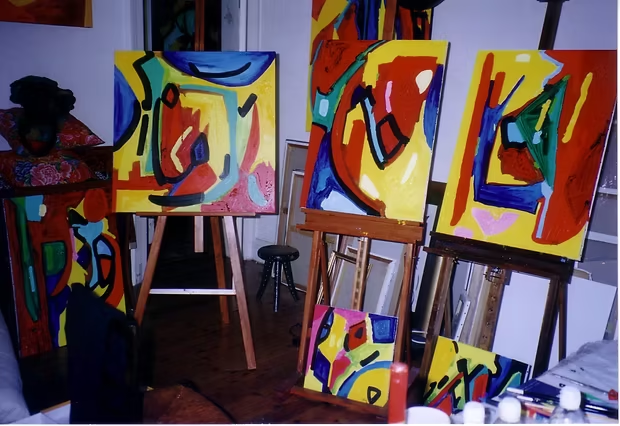
The Venice I paint is a singular Venice; it has the colors of the Tropics, their intensity, the simplification of the abstract line of a painter's eye, the wild character of a child who has always known the sea, and who has always dreamed of painting.

Venice is a chorus of uniques, which provokes memory, sharpens the imagination. She is the future of time; she never ceases to remind us, with so many detours and spells, so much constancy and shimmering, that the real is not, and that it will be our work.