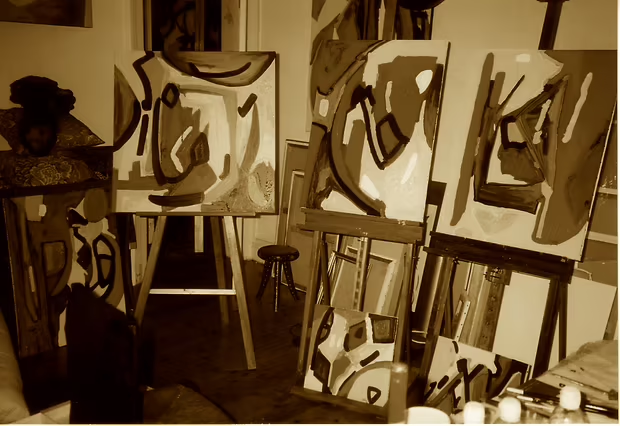
A painting is like an existence in shorthand, in concentrate. The completion of the painting is like its death: at last the whole takes on meaning. "Such as into himself at last eternity changes him." The ensemble of elements makes sense.
The position of the painter is twofold — this is fascinating, instructive, astonishing. At once I am the existing being, who makes decisions, takes directions, chooses colors, without knowing in advance what their meaning will ultimately be. And yet with each decision I aim at a meaning, I have a precise intention: this small piece of yellow must clearly stand out from this red and this blue, without anything overflowing, without anything being blurred — this is vital. Painting unfolds in a succession of important details, of balance, of contrasts to be conquered, without my ever knowing what meaning, in the whole of the painting to come, this particular care I have given to this balance, to this contrast, will have.
This is the very experience of the existing being who does not know where the decision of the moment will lead. There is a risk at every moment. At every moment one must decide, take a direction, a straight line, a curve, a color, even though the intended contrast may in the end be invisible, covered by other layers of paint, by other future decisions, and therefore as if lost.
This is also what always surprises, every time. The energy given to a detail, to a border, to a relief is as if forgotten in the end, covered over, lost. Everything takes on another meaning. And yet this new meaning that marks the completion of the painting was built from all these moments, all these risks, all these precise aims. This is perhaps the reason why a painting has density: it is a story in its very construction, it is a condensation, a concentrate of existence, a journey of existence, in its joys, in its agonies, in its losses, in its happy apparitions.
The position of the painter is twofold because he is this existing being who intensely lives his freedom at every moment, but at the same time he is like God who interrupts the journey. He decides on death, that is to say on the completion of the painting.
But the death of the painting is also its eternity. Through the encounter with the other, with others. The whole has taken on meaning, the painter has nothing to add, the painting enters into dialogue with those who behold it.
