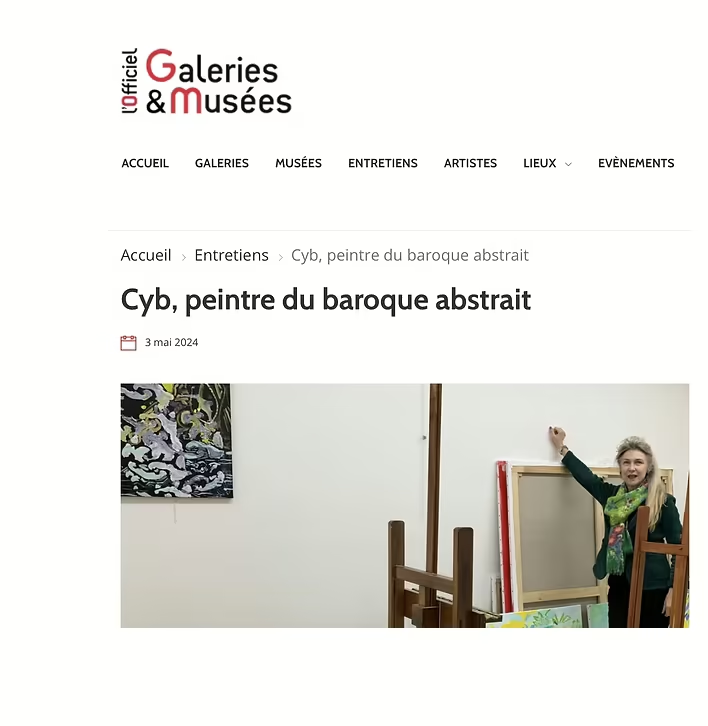
Green, yellow, red or blue… When we enter Cyb's studio, overlooking a garden where a few birds are chirping, we are greeted by a tumult of colors. Her abstract landscapes, nourished by philosophical and artistic reflections and by her relationship to music, energetically unfold sensory experiences. An encounter with a baroque and free artist.
You are CYB and you choose to work under a pseudonym…
Cyb: I come from a generation where one carries the name of one's father or one's husband. I did not want to be inscribed in either of these cases. Very young, I made the decision that my name would be Cyb. I liked the idea of having a pseudonym that could belong to either a man or a woman. In my first exhibitions in Lille, I remember a sculptor who had come to see me. "I would never have believed this was a woman's painting," he told me. From the start, choosing a pseudonym was a way of inscribing my art in freedom. My painting is a space of freedom. Through this choice, I distanced myself from a certain number of determinisms.
What made you want to paint?
Cyb: Being a painter was my first desire. I was given an art book at five and a half years old. I had seen three paintings in that book that struck me — a sunflower by Van Gogh, a Self-Portrait by Dürer where he depicts himself with slightly disheveled hair and plays ambiguously with femininity and masculinity, and a large painting by Vermeer, "The Art of Painting." I stopped at these three paintings. How can one manage to paint oneself in the act of painting? I was drawn to this reflexive aspect. It was also about establishing oneself as a subject. I wanted to do as they did. So everything started from an encounter. Many artists become artists this way. There is something of the order of shock.
I have always drawn, practiced oil pastels. I learned oil painting during my childhood in the shade of jasmine trees. I worked, read, made encounters, like those with Georges Mathieu around the age of 20. I had a coup de foudre for one of his canvases at 17. I saw him regularly and he initiated me into abstract art. We communicated through handwritten letters that I still possess… Malraux said of him that he was a Western calligrapher. He wrote with a quill… We would arrange meetings, he would recommend exhibitions to me and we would discuss them… My encounter with Georges Mathieu gave me the impetus to launch into abstraction.
I always say now — even though I have long since returned to referents, what is called the real world — that I remain an abstract painter. The question of reproducing what one sees does not interest me at all.
You studied mathematics, then philosophy. Why this choice?
Cyb: What interested me in both disciplines is conceptual rigor. I intensely experienced the joy of approaching a world other than the sensible world. The mastery, the confrontation of complexity through the concept — I did this extensively, and it formed me enormously.
I explored the complexity of existence on the one hand through the concept by doing philosophy in high doses, and on the other hand by cultivating and giving free rein to all this inner space within me that imperatively demanded expression. When I read in those years texts like Kandinsky's "Concerning the Spiritual in Art and in Painting in Particular" on inner necessity, it spoke to me completely. He alluded to these false questions of whether one was in the abstract or the figurative… He foresaw in advance that it was a sterile titanic battle… I was totally imbued with all of this.
You often speak of the notion of Abstract Baroque, central to your work. Can you tell us about it? What does abstraction bring to the baroque, and vice versa?
Cyb: In fact, the construction of this notion is also linked to Mathieu in my history. These two terms have no a priori connection. The possibility of abstraction is an open space, an exploration. That is what the encounter with him represented for me. Mathieu was a great admirer of Leibniz and his theory of possible worlds. Abstraction represents for me a way of very clearly marking this space of freedom beyond everything.
Why join the two terms? It is linked to one of my readings that had greatly enlightened me. It is the text by Eugenio d'Ors: "On the Baroque." In this text, he makes a distinction between two types of perceptions or artistic expressions in the world, which he calls the Classical Aeon and the Baroque Aeon.
These are like two different ways of seeing the world and expressing it through art. D'Ors does not see these two modes as antagonistic. They are not in competition but coexist as different ways of apprehending and showing reality. One is not a parody of the other. The baroque, with its attention to contrast, to instantaneity, runs through the entire history of art. It is about saying that there are "being-in-the-worlds" and mine, my being in the world, is the baroque.
In another very beautiful text by Philippe Beaussant, "Did You Say Baroque?", the author states clearly that the baroque thinker par excellence is Pascal. I keep in mind this passage from the Pensées: "We never hold to the present time." It is about having a demand to seize the singularity of the instant, at the edge of the abyss, being and already nothingness, aspiration to the infinite.
And then abstract baroque? It did not exist. I had no desire to follow in anyone's footsteps. I questioned what synthesized me most as an artist.
You have a sensitivity for icons…
Cyb: For me, the summit of visual art is the icon. A sacred art where the icon is a support for meditation, but much more. These are works painted by monks who create them while praying. The action of painting goes hand in hand with prayer. When the schism took place between the Eastern and Western Church, the Orthodox were accused of being idolaters. This schism would accentuate the distinction between the tradition of icons and the art of painting.
Later the baroque would give incredible ardor to many artists. Ultimately among the Orthodox, this place of representation that is painting already goes beyond itself with the icon. Not everyone has the right to paint an icon. The icon accompanies an entire spiritual trajectory. For me it remains the horizon of painting, something that allows one to go beyond the borders of the real world.
Saint Augustine said "To sing is to pray twice." There is this idea that in art, one rises higher than oneself. It is a work beyond works, an inexhaustible source of inspiration. I find this extremely moving and stimulating. I created an entire series of canvases called Rilska following my discovery in Bulgaria, in Sofia, of the crypt of the Saint Alexander Nevsky Cathedral. There was an entire collection of icons from the 14th to the 19th century that I had the opportunity to see alone. Orangey reds, greens… I believe moreover that it was from that trip that I began to be transported by green. I am not a Monk but modestly, at my scale, it is toward this breath that I paint.
An artist I loved very early on is El Greco. I realized much later that he was an icon painter! El Greco has this freedom regarding the question of perspective that comes to him from the symbolic space of icons. That is why many painters in the 20th century rediscovered this artist.
Is abstraction not an appropriate pictorial language for journeying toward the elevation you describe?
Cyb: Absolutely. When I met Georges Mathieu and he initiated me into abstraction, I was transported by Manessier and his stained glass windows. His stained glass windows that he calls "Passion" or which take up the different moments of the life of Christ in an abstract way are for me infinitely more powerful than any figuration. One is in relation with something beyond what one can depict. I have moreover a project to work one day on stained glass models. Perhaps in ink.
Moreover, I have always been astonished by this compartmentalization in painting between figurative and abstract. Kandinsky was very striking in 1911 when he said that this was not the subject. The question rests on an inner necessity. Rouault for example refers to elements of the real but he names his landscapes "mystical or interior landscapes." Van Eyck's Man in a Red Turban, what is it if not an abstract canvas? The entire personality is in the turban, in the red and the forms.
One senses in your work a desire to share a multisensory experience. You moreover have a passion for music… One would almost have the impression of seeing musical scores, of hearing sounds vibrate in your canvases at times.
Cyb: I did a great deal of classical dance and piano. Music, the relationship with the body… all of this is important to me. Opera is part of my baroque universe — my favorites are moreover Tristan and Isolde by Wagner and Alcina by Handel. For years I painted a great deal while listening to Bach. It is the intensity of sensation in all its dimensions that interests me.
In a previous exhibition: Living Pillars, I drew upon the famous poem by Baudelaire. There was the idea of Correspondences, "Perfumes, colors and sounds answer one another." One of my canvases was called Oliban, like incense. In the exhibition as a whole, there was this idea of scents, of vast spaces. A countertenor friend had come to see the "Living Pillars" exhibition. He remarked to me that they resembled a musical score. He said he heard sounds while looking! It is not deliberate but I appreciate that my canvases produce this effect.
The work of the composer choosing his notes and that of the painter choosing his nuances of color is fundamentally the same? Music is also a means of going beyond the limits of the real. Is that why it is so visible in your work?
Cyb: For Wagner one speaks of chromaticism. Scriabin has an entire theory on notes that he relates to colors. I agree with this assertion. Kandinsky claimed a freedom of distance from what is called the real by appealing to music. Music is not obliged to copy the song of the robin or the waterfall. Music is what connects us with what runs through us.
This great wave of life, one feels it in Wagner's music where the full orchestra becomes one of the characters of the opera. The music, and notably the orchestra, will say something other than what the protagonists say. There is something of the order of the unconscious, that one cannot catch, but which is there and which manifests itself in the music. In this sense, music always goes beyond what one tries to capture.
This is indeed similar to abstract painting. In the very birth of abstraction, there is this claim of being at a distance from what is called real, of drawing closer to the invisible and to what goes beyond what one can perceive.
I entitled the canvas "Stromboli" because it was a metaphysical type of experience. In this series of canvases, I tried to account for something that relied on the concrete reality of "Stromboli" which rumbles like a lion, which vomits its red stars, its fumaroles and its lights… But what interests me is above all to account on the canvas for this sensory, instantaneous experience.
Is this somewhat what the abstract expressionists were tending toward? Do you recognize yourself in their approach?
Cyb: Rothko was trying to provide access through his vibrations to another space, one that allows us to give ourselves the energy to continue to create, to face, to love… There is indeed something of that in my approach.
"There is therefore the inner experience of a necessity to express oneself, to make this voyage of patient and tenacious deepening, to find the plastic means of this voyage when one is a painter. (…) My work as a painter resides in this tearing away from the ordinary course of life; it transcribes, expresses the freedom of a detached, unfettered perception. That is why my watchword as an artist for years has been stated thus: 'insurrection of color.' I believe in inner insurrection, in the free world of which each of us is the seed. I therefore defend no cause, except that of freedom itself, of which art is the most radical manifestation." Does this text entitled "Free" within your abecedary book Abstract Baroque not summarize your entire approach?
Cyb: Indeed. This text had been written for the review Area. I was saying something fundamental about my condition as an artist and my practice. For me, art is that. This radicality is fundamental. Artists precede us and show us through their works that they have waged this battle of radicality. That is moreover why so many different artists interest me. Some have even become Friends. There is this text… The Letter to El Greco by Kazantzaki. In this text, the author evokes in his young years his great readings, his great encounters with artists, tells us that he speaks to works… It is thanks to them that he constituted himself, that he tamed the world; his artists nourished him so that he could trace his own path. The resonances, the dialogical relationship I maintain with artists have built me.