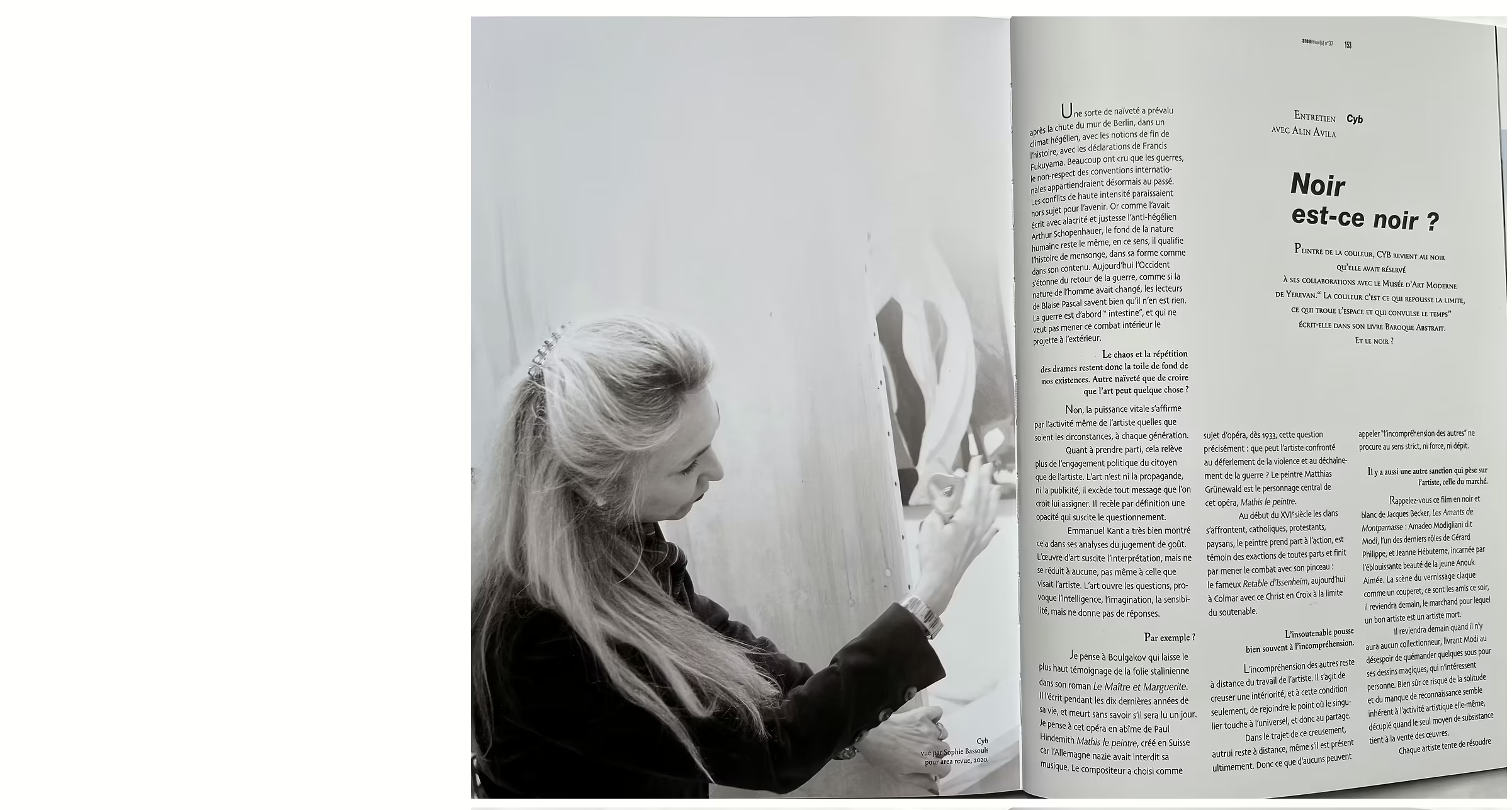
INTERVIEW WITH ALIN AVILA — Cyb
Is black really black? A painter of color, CYB returns to the black she had reserved for her collaborations with the Museum of Modern Art of Yerevan. "Color is what pushes back the limit, what pierces space and convulses time," she writes in her book Abstract Baroque. And black?
A sort of naivety prevailed after the fall of the Berlin Wall, in a Hegelian climate, with notions of the end of history, with the declarations of Francis Fukuyama. Many believed that wars, the disregard for international conventions, would henceforth belong to the past. High-intensity conflicts seemed irrelevant to the future.
Yet, as the anti-Hegelian Arthur Schopenhauer had written with alacrity and accuracy, the core of human nature remains the same. In this sense, he qualifies history as a lie, in its form as in its content. Today, the West is astonished by the return of war, as if human nature had changed; readers of Blaise Pascal know full well that this is not the case.
War is first "intestine," and whoever does not wish to wage this inner battle projects it outward.
Chaos and the repetition of dramas therefore remain the backdrop of our existences.
Another naivety to believe that art can do something?
No, vital power asserts itself through the very activity of the artist whatever the circumstances, in every generation. As for taking sides, that pertains more to the political commitment of the citizen than of the artist. Art is neither propaganda nor advertising; it exceeds any message one believes one can assign to it. It harbors by definition an opacity that provokes questioning.
Immanuel Kant showed this very well in his analyses of the judgment of taste. The work of art provokes interpretation, but cannot be reduced to any one, not even to the one the artist intended. Art opens questions, provokes intelligence, imagination, sensibility, but does not give answers.
For example?
I think of Bulgakov, who leaves the highest testimony of Stalinist madness in his novel The Master and Margarita. He writes it during the last ten years of his life and dies without knowing if he will ever be read.
I think of that opera en abyme by Paul Hindemith, Mathis the Painter, premiered in Switzerland because Nazi Germany had banned his music. The composer chose as his opera subject, as early as 1933, precisely this question: what can the artist do when confronted with the surge of violence and the unleashing of war?
The painter Matthias Grünewald is the central character of this opera, Mathis the Painter. At the beginning of the 16th century, factions clash — Catholics, Protestants, peasants —; the painter takes part in the action, witnesses atrocities on all sides, and ends up waging the battle with his brush: the famous Isenheim Altarpiece, today in Colmar, with that Christ on the Cross at the limits of the bearable.
The unbearable very often leads to incomprehension.
The incomprehension of others remains at a distance from the artist's work. It is a matter of excavating an interiority and, only on this condition, of reaching the point where the singular touches the universal, and therefore sharing.
In the course of this excavation, the other remains at a distance, even if they are ultimately present. Therefore what some may call "the incomprehension of others" provides, strictly speaking, neither strength nor spite.
There is also another sanction weighing on the artist: that of the market.
Remember that black-and-white film by Jacques Becker, The Lovers of Montparnasse: Amedeo Modigliani called Modi, one of Gérard Philipe's last roles, and Jeanne Hébuterne, embodied by the dazzling beauty of the young Anouk Aimée. The opening night scene strikes like a cleaver: "these are friends tonight, he will come back tomorrow," the dealer for whom a good artist is a dead artist.
He will come back tomorrow when there will be no collector, delivering Modi to the despair of begging for a few coins for his magical drawings, which interest no one.
Of course, this risk of solitude and lack of recognition seems inherent to artistic activity itself, tenfold when the only means of subsistence depends on the sale of works.
Each artist attempts to resolve this problem from their particular situation: Paul Cézanne was the son of a banker, Gustave Moreau a professor at the Beaux-Arts…
Let us return to your work, following a stay in Stromboli…
The latest exhibited canvases follow a radical experience lived last spring. The black water, at night, a few meters from the Sciara del Fuoco, that immense space of black lava, path from the depths of the rumbling earth: Iddu, "him," the volcano, at night, on a frail vessel.
There, I understood that Stromboli, black, rising from the black sea, rumbling, hurling its red sparks into the great silence of our anguish, could of course have been considered a god. It is an archaic experience that speaks far more eloquently than the accumulation of anthropology books. Or rather, one understands why all those books were written: to grasp something of the mystery of what connects us to the earth, on the one hand, and to our fellow humans in our frail existence, on the other.
There is something profoundly human in the radical humility of our condition. Before the sovereign, immeasurable power of Iddu, the extent of our fragility makes us bend the knee — an inner, ontological reverence that marks the recognition of something greater than oneself, infinitely greater than oneself.
Blaise Pascal is the basso continuo — as one says in music — of my readings. He speaks of the misery of man without God, and of the desire for the absolute, of human desire as an infinite abyss that can only be filled by an infinite and immutable object, that is to say, by God himself.
The archaic experience at night before Stromboli made me precisely touch that point where the abyss falters, that point of silence where the stranger beside you in the vessel becomes a fellow human being.