Who is blue, what is its name? Where does red stand? And yellow, and green — are they found in the meadow or on the retina?
This tangerine blends into the grass for you, the color-blind one who names them alike. Who lies?
Is it words that lead us astray, since night erases the green of the grass, makes the orange lie by ceasing to be so.
Considering the white and red of porphyry, John Locke makes this observation: Let light not fall upon it, its color vanishes, and the Porphyry no longer produces such ideas in us. Does light return, the Porphyry once again excites in us the idea of these colors. Can one imagine that no real alteration has occurred in the Porphyry through the presence or absence of light; and that these ideas of white and red are really in the Porphyry when it is exposed to light, since it is evident that it has no color in darkness?
Here is darkness; colors, like startled animals, sink into it to the point of no longer being.
Chromo/Chronos
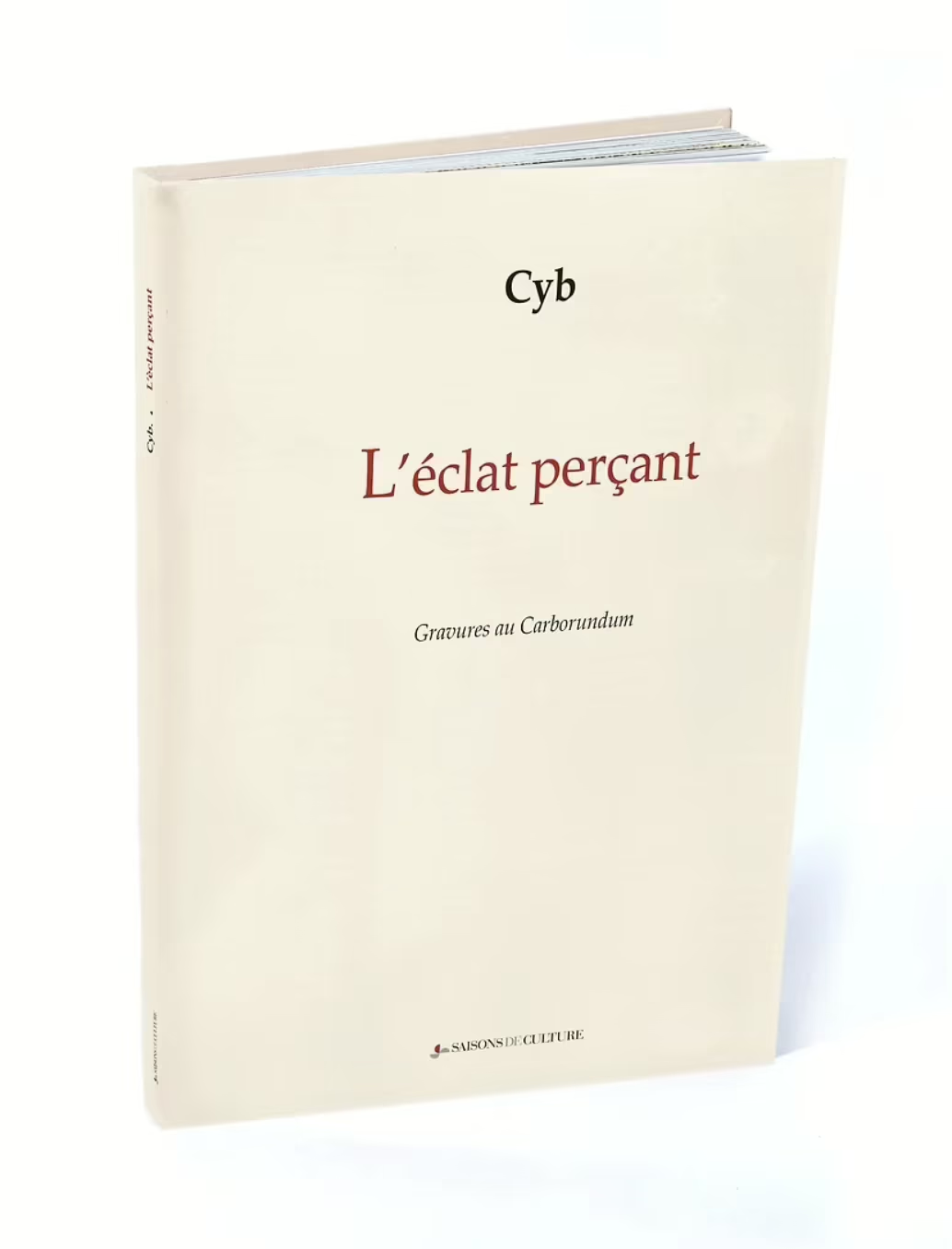
I too lose myself trying to understand them, for here, in Cyb's work, colors do not particularize an object but constitute themselves as thought while they organize themselves within the work.
To say that painting is made of color is a truism, whether it refers to the real or expresses its materials. But in Cyb's work, colors, reduced to a minimum, aim at a space whose depths organize themselves in the confrontation of tones; as for the arrangements of forms, one may imagine they are responses to what produced sensation in her:
Opera tears open and summons the red — the black flash upon the red curtain.
Art in its original wound binds a green sky of promises to a plowed earth.
Italy and Greece beneath red and yellow fires invite the permanence of a blue absent on paper, yet persistent under the effect of a suggestion of the senses, well beyond the retina.
Just as Japan, which in the artist's recent canvases summoned such a green that one cannot forget its stridency.
Black for writing, inscribing, searching, seeking wisdom. And finally colors to inhabit the world poetically.
Behind these doors, a room in the inventory of what attracts Cyb.
Evident for those who know the artist, but why hide them behind a door if not to sharpen the mystery and let alchemy imprint itself upon great studious brows.
As for the poet, he placed them at the threshold of vowels, promising in his verses to reveal to us the latent births of colors. Which is what Cyb does in her own way.