INTERVIEW WITH AKEMI NAKATA — Marie Denieuil
The Purpose of Art, the Beauty of Life
Nicolas Berdiaev, a Franco-Russian philosopher, remains profoundly marked by a mystical anarchism critical of the temporal forms of religion. He left Moscow in 1922 for Berlin and joined France in 1924. The Sundays of Clamart that he organized at his home were conducive to passionate exchanges between intellectuals, theologians and poets from all horizons, among whom Emmanuel Mounier, founder of the review Esprit, Gabriel Marcel, Jacques Maritain, Vladimir Jankelevitch and Marie Skobtsov… Born in 1874 in Kiev, he passed away in Clamart in 1948, leaving behind an important body of work. Marie Denieuil is a doctoral student in philosophy on the concept of creation in Berdiaev's work.
You work on the philosopher Nicolas Berdiaev. Why is the notion of creation central to his work?
The concept of creation is indeed the energy core of his thought. Berdiaev is a complete mind. He took an interest in philosophy, but also in politics, religion, art, society, love, the person and their singularity. His thought refuses the compartmentalization of these domains in relation to one another because deep down they would all refer back to the same vital dynamic, a universalism, which would unify
Which artists seem to you today to participate in the creative dynamic as Nicolas Berdiaev understands it?
Two artists come to mind whose pictorial signatures seem opposed but who seem to me nevertheless to join this same dynamic of creation. First, the work of Vladimir Velickovic. It is a tormented, chaotic work, a true sponge of all the Nazi atrocities perpetrated in the former Yugoslavia. It is extremely dark in appearance. In appearance, because one senses in him a fierce struggle to transfigure his visions of horror into aesthetic phantoms, a struggle to symbolically transcend evil, of which he was an eyewitness, without however denying its effective reality. His aestheticization of evil is not decorative. His aim is not to please but to displease, to "hurt" the eyes that look at his works, to scar the eye. It must be admitted that some of his paintings are threatening, aggressive, very disturbing. I think for example of Aggression (1972) where one sees a woman's crotch devoured by a rat. The place of life becomes precisely the site of the violation of life, the beginning of annihilation and putrefaction, a sort of inverted Origin of the World. But is the death drive not on the same channel as the life drive? Behind the bark of this appearance, it is no longer merely a broken and dark life that one perceives but indeed a vital energy that explodes, a soul in the midst of a detoxification cure, awaiting a new heaven and a new earth, awaiting resurrection.
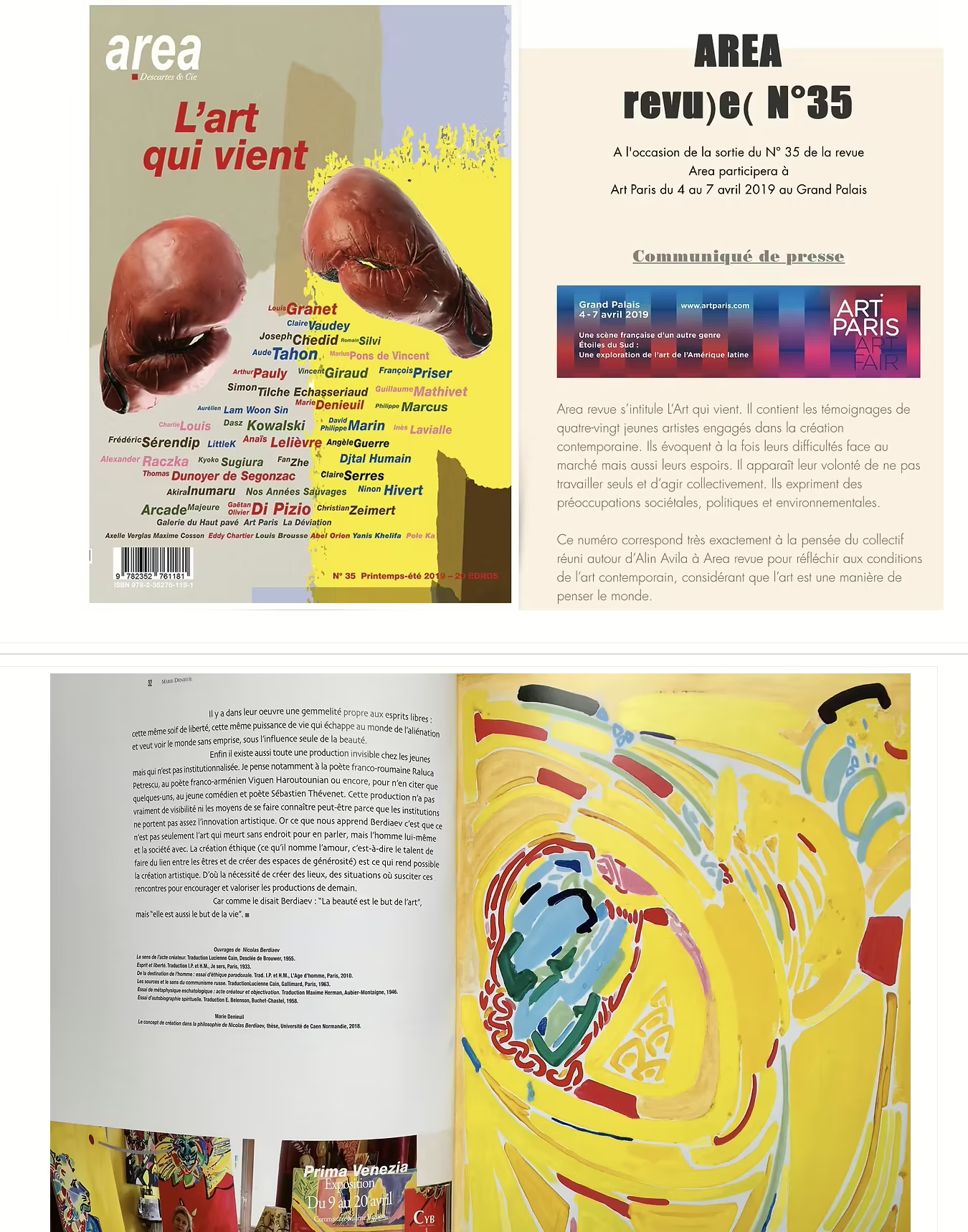
Then the work of Cyb. It is a volcanic painting. Immediately solar. It colors the retina and gives, as Rimbaud said, "the darning eye" – flashes in the eyes. It does not choose the detour through the representation of the "chaotic ugliness" of the world, as Berdiaev puts it, but exalts the "beauty of the cosmos" in its raw state, in its nudity. Resurrection operates through color where red and yellow predominate and orchestrate the other colors. His series on Venice moreover reminds me of Berdiaev's words during his trip to Italy, where he wrote almost in one burst The Meaning of the Creative Act: "In me a world of thoughts about the creation of the Renaissance was awakening."
There is in their work a twinship proper to free spirits: that same thirst for freedom, that same power of life that escapes the world of alienation and wants to see the world without domination, under the sole influence of beauty.
Finally, there also exists an entire invisible production among the young that is not institutionalized. I think notably of the Franco-Romanian poet Raluca Petrescu, the Franco-Armenian poet Viguen Haroutounian, or again, to name but a few, the young actor and poet Sébastien Thévenet. This production has no real visibility nor the means to make itself known, perhaps because institutions do not sufficiently support artistic innovation. Now what Berdiaev teaches us is that it is not only art that dies without a place to speak of it, but man himself and society with it. Ethical creation (what he calls love, that is to say the talent for creating bonds between beings and creating spaces of generosity) is what makes artistic creation possible. Hence the necessity of creating places, situations where these encounters can be fostered to encourage and value the productions of tomorrow.
For as Berdiaev said: "Beauty is the purpose of art," but "it is also the purpose of life." ■
Works by Nicolas Berdiaev
The Meaning of the Creative Act. Translation Lucienne Cain, Desclée de Brouwer, 1955.
Spirit and Liberty. Translation I.P. and H.M., Je sers, Paris, 1933.
The Destiny of Man: An Essay in Paradoxical Ethics. Trans. I.P. and H.M., L'Âge d'homme, Paris, 2010.
The Sources and Meaning of Russian Communism. Translation Lucienne Cain, Gallimard, Paris, 1963.
Essay on Eschatological Metaphysics: Creative Act and Objectivation. Translation Maxime Herman, Aubier-Montaigne, 1946.
Essay on Spiritual Autobiography. Translation E. Belenson, Buchet-Chastel, 1958.
Marie Denieuil
The Concept of Creation in the Philosophy of Nicolas Berdiaev, thesis, University of Caen Normandy, 2018.